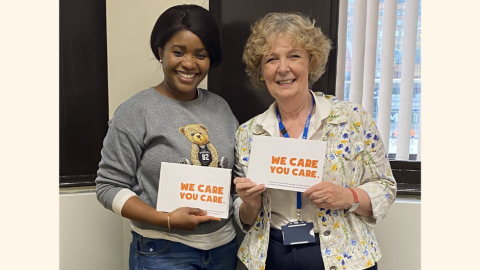

Kinship Care Week (6–12 October) is a national campaign to recognise, celebrate and raise awareness of kinship families across England and Wales.
It’s a chance to shine a light on the vital role of kinship carers – grandparents, aunts, uncles, siblings, and family friends – who step up, often at very short notice and in the middle of a crisis, to give children safe, stable and loving homes. More than 141,000 children in England and Wales are growing up in kinship care, staying connected to their families, roots, and communities.

Here in South Tees, hundreds of kinship carers are stepping into these incredible roles , often with little financial or emotional support or recognition. Local carers’ experiences, alongside national research, show that many people become kinship carers with little notice, time, information or support to consider their options. This often leads to significant sacrifices and a lack of recognition, leaving carers feeling unsupported. For example:
- Kinship carers do not have a right to statutory paid leave from work when they take on a child – unlike birth or adoptive parents.
- Nearly half of kinship carers (45%) leave jobs or careers to care for a relative’s or friend’s child, preventing that child from going into foster care. (Kinship 2025)
- Three in four kinship carers (74%) were in paid work before stepping into their caring role. Four in five (80%) have not returned to work since. (Kinship 2025)
- While some financial help is available, such as Child Benefit, it is far below the level of support provided to foster carers. (Kinship 2025).
- A quarter (25.3%) of kinship care households contain one or more residents whose long-term physical or mental health condition or illness limited them a lot, compared with 10% of parental households. (Census 2021)
One kinship carer from Middlesbrough that we spoke to described how becoming a kinship carer forced them to leave their career:
“I had to leave work to look after my niece as she was struggling with the transition to live with us. I worked as a teacher and was planning early retirement. Instead, my early retirement is now home schooling, counselling, mediating, and caring.”

And yet, evidence shows that investing in well-supported kinship care delivers better outcomes for children and for the public purse. Kinship carers contribute an estimated £4.3 billion to the economy by raising children, many who would otherwise be looked after in unrelated foster or residential care. For every 100 children looked after in well-supported kinship care rather than local authority care, the state saves £4 million per year and increases the lifetime earnings of those children by £2 million.
What the government says
Josh MacAlister, the government's minister for children and families, has said: "We have already announced that we will trial a financial allowance for kinship carers, and we are trialling family network support plans.
"We are also introducing a new law to make sure councils set out clear support for carers - breaking down barriers to opportunity for children by ensuring that they and their carers get the support they need...Our ambitious reforms to the children's social care system will help keep more families together safely, reducing the number of children needing care across the country."
New evidence: Handle with Care 2025
Kinship’s latest annual survey, Handle with Care 2025, gathered the views of more than 1,900 kinship carers. The findings show:
- Financial hardship remains common.
- Many carers and children live in unsuitable housing conditions.
- Poor support continues to put children’s stability at risk.
Key recommendations from the report include:
- The UK and Welsh Governments should equalise financial support between kinship carers and foster carers.
- The UK Government’s Kinship Allowance Pilot should be accelerated and new guidance published to reduce unacceptable levels of variation and poor practice in the delivery of financial support.
- In the interim, local authorities should emulate leading practice and provide non-means tested allowances.
- The UK Government’s parental leave and pay review should recommend a new right to statutory paid employment leave for kinship carers.
- Local authorities should proceed at pace to deliver their kinship local offers and improve the information and signposting provided to all kinship carers.
- Governments and local authorities should invest in the delivery of tailored and accessible training and support services for kinship carers, including peer support, paying particular attention to support around children’s social, emotional and mental health needs and circumstances which increase the risk of family instability.
Read the full report here https://kinship.org.uk/our-work-and-impact/policy-and-influencing/reports-and-publications/handle-with-care/
Local support in South Tees
Middlesbrough Council and Redcar & Cleveland Borough Council both offer dedicated kinship support with access to training, advice, peer support, signposting and referrals. You can find out more here .

Kinship carers can also get wider support through Carers Together and Teesside Mind. If a child in the family is also a Young Carer (someone under 18 who looks after a parent, sibling or relative) the Junction Foundation (link) offers tailored support.
We know that care within the family is the best option for children; to be with someone they know and trust. Yet talking to people it still feels like too many kinship carers feel unsupported with not enough resource or support available for them. Change is on the horizon, but it must go further and faster.